The Presentation and the Presenter
One develops the craft of presentation. The other develops the human being behind it. Together, they shape a signature presentation style.

The Skill You Are Already Using
How many times have you presented today? Perhaps you explained an idea to a colleague. Maybe you led a meeting, taught someone, interviewed for an opportunity, negotiated, asked for support, influenced a decision, sold a product, championed a cause, or tried to help someone else understand your point of view.
Every one of those moments was a presentation. Yet most people still believe a presentation begins when they open PowerPoint, create slides, walk into a conference room, or step onto a stage.
You are already presenting
Presentation is far more intrinsic to your life than that. Whether you recognize it or not, you are always presenting. You present your ideas, your expertise, your leadership, your credibility, your values, and your point of view.
The surprising part is that almost nobody teaches you how to do it properly. You are already presenting, but you may never have learned how to do it with intention.
The breathing analogy
Nobody had to teach you how to breathe. You breathe every day because breathing is intrinsic to being alive. But learning to breathe better can improve your energy, your performance, and even the quality of your life.
Presentation is remarkably similar. You are already presenting. The question is whether you want to continue relying on instinct, imitation, guesswork, and last-minute improvisation, or learn how to present with greater intention.
Presentation Is an Enabling Meta-Skill
Presentation is not merely public speaking or creating slides. It is the ability to express an idea, communicate expertise, earn trust, influence decisions, guide understanding, and move people toward meaningful action.
Presentation is a meta-skill. It enables every other skill you possess to rise higher. Your technical knowledge, leadership ability, creativity, experience, and expertise become more valuable when others can understand, trust, remember, and act on them.
The skill nobody teaches
Yet schools, colleges, universities, and workplaces rarely teach this enormously important skill properly. Most people learn it on the fly.
They borrow techniques, copy styles, rely on attractive slides, imitate speakers they admire, prepare at the last minute, and hope that confidence will carry them through. They never realize how many opportunities depend on their ability to communicate their ideas more clearly, persuasively, and memorably.
The Two-Layer Learning Architecture
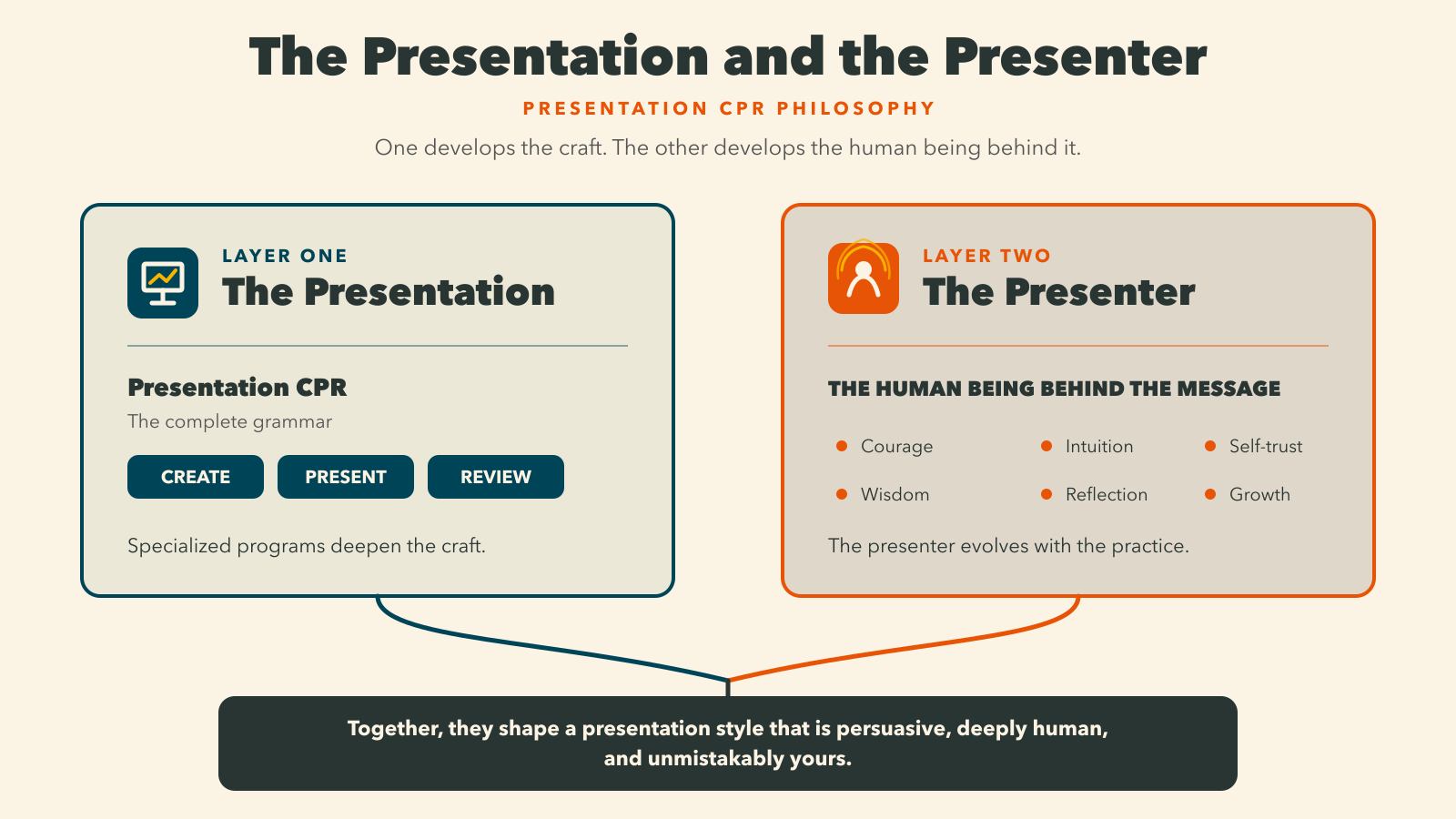
That is why my learning philosophy has two connected layers:
- The Presentation includes Presentation CPR, which teaches the core grammar through Create, Present, and Review, as well as specialist programs that explore individual areas of presentation craft in greater depth.
- The Presenter develops the human being through courage, intuition, self-trust, wisdom, reflection, personal growth, and Heroic Intuitive Writing.
The first layer develops the complete craft of presentation. The second develops the person who must bring that craft to life.
Layer One: The Presentation
Presentation CPR: The grammar
Presentation CPR provides the fundamental grammar of a good presentation. It is a comprehensive methodology organized around three fundamental areas:
Create. Present. Review.
The methodology is exhaustive because it helps you understand the full landscape of presentations. But it is not a rigid formula that you must follow mechanically every time you present.
Arithmetic gives you the fundamentals
Think about basic arithmetic. You learn addition, subtraction, multiplication, division, fractions, and percentages.
You do not use all of them in the same sequence every day. You don't solve every problem by starting with addition, moving to subtraction, and ending with percentages. You understand the individual principles, recognize the problem in front of you, and then select and apply the appropriate operation.
Over time, the fundamentals become instinctive.
Grammar gives you creative freedom
Grammar works in a similar way. Learning grammar does not write your novel, article, speech, or script for you. It gives you the foundation and structure to create something original.
Once you understand the rules, you can use them in sequence, use them out of sequence, or select only the rules you need. Eventually, you can even break them intentionally because you understand what you are doing and why.
Presentation CPR gives you that grammar. It does not give everybody the same presentation style. It provides the foundations, principles, frameworks, and tools to develop a presentation style that is unmistakably your own.
What you create with that grammar depends on your judgment, experience, imagination, and unique point of view.
Create begins with solid design
A presentation does not begin when you start speaking. It begins with solid design. The Create stage helps you build that design.
You begin as a subject-matter expert who understands the value of your knowledge. But expertise alone is not enough. You must learn how to transform that expertise into something another person can understand, trust, remember, and use.
You identify your audience and understand the world from their perspective. You clarify the problem you are solving and define the transformation you want to create. You generate ideas through logical, emotional, and ethical appeal.
You discover and distill your Big Idea. You build a clear outline and decide how to organize and sequence your ideas. You develop headlines and taglines that make those ideas easier to understand and remember.
You create the architecture of the presentation, often through the structure and movement of story. You choose the stories, analogies, examples, demonstrations, evidence, and presentation devices that will help your audience connect with the message.
You move deliberately from ideas to outline, from outline to script, from script to scenes, and from scenes to slides. The presentation software does not shape your thinking. Your thinking shapes the presentation.
That solid design becomes the foundation for everything else.
Present stands on Create
Only after that foundation exists are you ready to present. The Present stage doesn't begin with superficial performance techniques. It begins with the understanding that strong delivery sits on strong design.
You know your subject and understand your audience. You know the problem you are solving and your Big Idea. You understand your sequence, headlines, story architecture, supporting evidence, and presentation devices.
Because your thinking is clear and your structure is secure, you are better prepared to communicate with confidence and adapt without losing your direction. You then learn to understand the delivery challenges you may face. If you don't understand what you are up against, it becomes much harder to prepare for it or overcome it.
You learn to create sticky moments that stay with the audience and improve the signal-to-noise ratio so the essential message isn't buried under unnecessary information. You understand the value of brevity.
You learn that a presentation can begin before the formal beginning through the audience’s first impressions, expectations, and experience of you. You learn to balance ethos, logos, pathos, and kairos so that credibility, logic, emotion, and timing work together.
You diagnose stage fright instead of treating it as one universal problem. You develop verbal and nonverbal communication that creates trust, connection, confidence, and enthusiasm.
You consider your eye contact, facial expressions, posture, gestures, movement, voice, and presence. You design introductions that earn attention, use transitions that guide the audience from one idea to another, and create conclusions that provide meaning, resolution, and a reason to remember the message.
You also learn to handle expected, unexpected, and difficult questions without losing your composure or the presentation's direction. Present is not separate from Create. It stands on it.
Review works before and after
Review operates both before and after you present. Before the presentation, Review becomes your preflight check.
You examine whether the presentation has the foundations it requires. You check the audience, problem, Big Idea, structure, sequence, stories, evidence, slides, delivery, transitions, conclusion, timing, and preparation. You make sure that what you have created is ready to leave the ground.
After the presentation, Review becomes an opportunity to learn. Even when a presentation succeeds, something can always become clearer, stronger, simpler, more persuasive, or more memorable.
You examine what worked and notice where the audience connected or became confused. You identify what should be retained, removed, clarified, shortened, strengthened, or redesigned.
Before you present and after you finish, Review helps you improve both the presentation and your judgment as a presenter. Create, Present, and Review give you the grammar of presentation.
But the learning ecosystem does not end there.
Specialized programs: Deeper presentation craft
Presentation CPR provides the comprehensive grammar. Presentation craft programs let you dive deeper into specific aspects of that craft.
Most Presentation CPR programs fall into this category.
Deep dives into presentation craft
You may want to explore how to design an effective workshop. You may want to understand image cropping and how framing changes an image's meaning and impact.
You may want to study slide-layout fundamentals. You may want to understand typography and learn how to design better slides with type.
You may want to develop stronger visual communication, storytelling, persuasion, facilitation, or other individual presentation capabilities. These programs do not replace Presentation CPR. They let you choose a specific part of the grammar and study it in greater depth.
Presentation CPR gives you the complete map. Presentation craft programs let you explore specific territories more deeply.
Layer Two: The Presenter
Every good presentation contains two things:
The presentation and the presenter.
Presentation CPR and presentation craft programs primarily develop presentation skills. Presenter-development programs develop the human being behind the presentation.
These programs are separate from the Presentation CPR framework. They are not presentation-skills modules disguised as personal development.
Developing the human being
They explore qualities such as courage, intuition, self-trust, wisdom, purposeful goal setting, reflection, and personal growth. Heroic intuitive writing, for example, uses journaling and reflective writing to help someone understand their inner voice, thinking, intuition, and experience more deeply.
These subjects may not appear directly connected to presentation technique. But developing the person will inevitably affect how that person communicates, creates, connects, decides, and presents.
The athlete develops both
Think about an athlete. An athlete may practice a particular shot, movement, or technical skill required by the sport. But the athlete also develops stamina, discipline, judgment, courage, concentration, resilience, and self-awareness.
One form of training develops the specific craft. The other develops the human being who must perform that craft.
Presentation works in the same way. Presentation craft programs deepen particular presentation capabilities. Presenter-development programs strengthen the courage, intuition, self-trust, and stamina of the person behind the presentation.
They are separate but subtly related. One develops the presentation. The other develops the presenter.
Together, they create a more complete learning journey.
Why This Website Explores Both
That is why this website explores both the presentation and the presenter. Some articles help you strengthen your message, structure, and craft. Others explore the courage, intuition, self-trust, spirituality, and inner development of the human being behind that message.
These are not unrelated bodies of work. They develop two sides of the same act: presenting something meaningful to another person.
Who Presentation CPR Is For
Presentation CPR is for subject-matter experts. You may work in a corporate environment. You may be an independent presenter, trainer, coach, consultant, entrepreneur, business owner, or content creator.
You may never consider yourself a presenter at all. But if you possess valuable expertise, have an idea worth sharing, or need others to understand and act on your thinking, presentation is already part of your life.
Presentation CPR is for you if you are prepared to do the work required to intentionally develop that ability.
This is not a shortcut
It is certainly not for you if you are searching for shortcuts, hoping to wing it, or looking for a collection of superficial techniques that will create an impressive performance without a strong foundation.
A good presentation is a labor of love. It requires thought, curiosity, exploration, preparation, design, revision, and practice.
Presentation CPR does not promise to remove that work. It gives the work structure, purpose, and direction.
The Central Promise
You are already presenting. You have been presenting throughout your life, even if nobody taught you to recognize it.
Presentation CPR helps you understand the grammar, learn the fundamentals, develop the nuances, and eventually build the instinct to know what to use, when to use it, and why.
Know the rules, then choose
Once you understand the rules, you are no longer trapped by them. You can use them in sequence, use them out of sequence, select the ones the situation requires, or even break them intentionally.
The objective is not to make you sound like somebody else. It is to help you transform your expertise and unique point of view into presentations that are persuasive, deeply human, and unmistakably yours.
I give you the grammar of a good presentation. What you create with it depends on your imagination.